Sign up to occasional emails

Showing posts with label rubber failure. Show all posts

Saturday, 16 January 2016

I'll get a second-hand pulley, she'll be right mate!

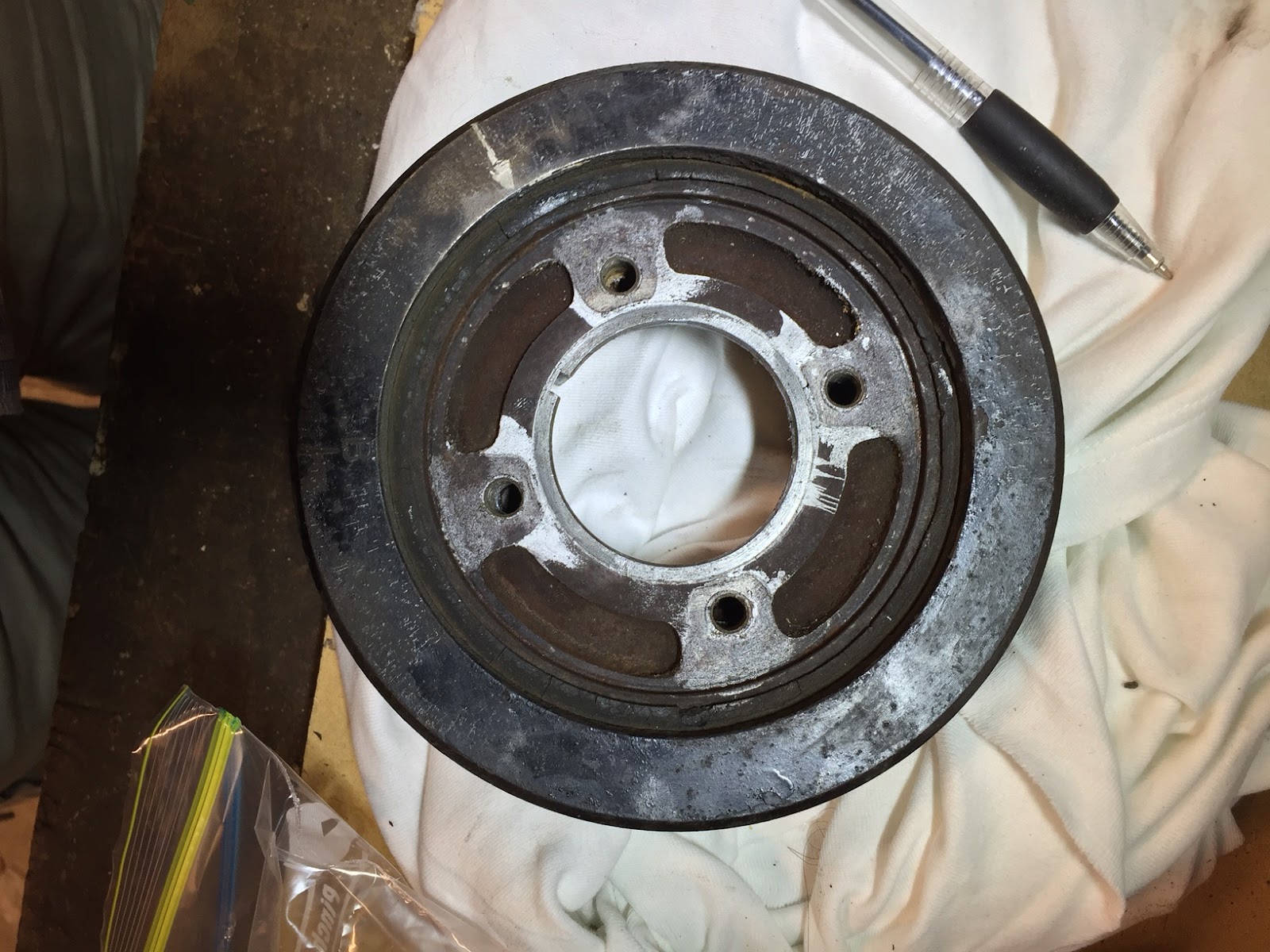
So your crank pulley is broke and you are shopping around for another one and the wrecker has a second hand one from the same make and model of car.
If your car is 10 years of age or older, there's a good chance that the pulley is as close to munted as the one you just took off the crank shaft.

Why?

Because RUBBER is why.
Rubber is the part that most often fails in a crank pulley, crank balancer or harmonic damper.
Rubber is an organic substance that breaks down with heat, water, oil, use and simple age.
All rubber parts of your automobile are going to die a slow sad death at some stage and require replacement.

When the rubber dies it usually does one of two things:
It cracks, shrinks, dries out and gets hard as a piece of wood.
It melts into a soft gooey jelly that is very messy to clean up.

So replacing your harmonic damper with a second-hand damper that may cost you just as much as a rebuilt damper means that it is inevitable that you will have to replace it again soon.

It also puts your precious automobile's engine at risk of catastrophic failure.
Check out our other blog posts to find out why.

We are totally happy to repair and re-rubber any second-hand or original OEM damper for you before you put it on your vehicle.

Care for your engine by buying it a re-manufactured damper/pulley or a new damper.
v12 Jaguar Etype before repair

v12 Jaguar Etype after repair before painting


Sunday, 10 May 2015

Signs a crank pulley or harmonic damper is malfunctioning

It's hard to know what the problem is when your engine begins vibrating at odd speeds, or your passengers start being ill, or the windows wind themselves down.
These are all symptoms of the damper being out of whack.

Rubber weakens with age and also deteriorates due to excessive heat, oil exposure, solvent exposure, and contraction. So what happens when a harmonic damper is malfunctioning? What are the symptoms?
Here's a handy list for you to check out.

1.  Deterioration of the rubber between the hub and the outer ring. Shown as cracking, bulging or shrinking instead of forming a smooth layer level with the metal components. This will be likely in any crank pulley over 10 years old because of the natural deterioration of the rubber. So old OEM dampers may well not last well or perform their duty even if they have only sat on the shelf for the past 10+ years.
Don't forget rubber is a natural product that simply deteriorates over time.


2.  Any wobble of the balancer or wobble in the drive pulley.

3.  Excessive engine vibration.

4.  Crankshaft cracking or failure.

5.  Squeaking that does not stop when all other possible sources have been eliminated.

6. Excessive bearing wear.

7.  Excessive gearbox wear or failure.

8.  Failure of other rotating or reciprocating engine elements.

9.  Loose flywheel or pulley bolts.

10.  Slipping, slapping or noisy drive belts. Having to change belts frequently.

11.  Loss of horsepower and lessened fuel efficiency.

12.  Highly polished asymmetrical spons in the pulley grooves, means a warped inertia ring.

13.  Elongation of the balancer key-way or wear on the balancer hub or crankshaft.

14.  Failure in the alternator, power steering pump, A/C or water pump.

15.  Engines that don't run properly when adjusting the timing.

16.  Irregular idle.

When a damper wears, what happens, at a minimum, is that the outer ring will move so the timing mark will be in the wrong position. Or, at worse, the ring comes completely off while you're driving and becomes the worlds heaviest "Frisbee" under your hood. Your radiator is one of the favorite items your newly found toy likes to go through.

Causes of damper failure:- age, cracked hub keyways, incorrect damper for the engine or crankshaft, damage from improper mounting or removal. Bent or out of balance drive shafts, buckled or out of balance driving wheels, excessive heat and age.


If you have a high performance engine without fitting a correctly calculated high performance damper, a standard damper could completely self-destruct sending high speed shrapnel throughout the engine bay with destructive consequences that are not hard to imagine.

It is important to understand that while an engine from any manufacturer is designed by a team of qualified engineers, after market dampers are often designed by people who do not understand the very important principles of physics that are used to design harmonic dampers. Great care should be taken in the selection of any damper to be used as replacement for a stock or for use in high performance engines.

If a cast iron damper is replaced with a steel damper care should be taken that the mass of the steel damper is equal to the mass of the damper being replaced. Because steel is much lighter than cast iron this means the damper will be somewhat larger than the one being replaced.

I have seen after market-dampers that have failed in spectacular fashion after brief use and have customers who are returning to a stock damper due to unsatisfactory results with after-market replacements. As in any field of after market componentry there is a small sector that know what they are doing and a wide range of pirate imitators.

John Mallett